What Does Dubbing Mean in Movies Explained
Ever watched a Hollywood blockbuster in a language that wasn't English and felt like it was made just for you? That's the magic of dubbing.
At its core, dubbing is the process of replacing a film's original dialogue with a translated version, performed by voice actors in the new language. But it’s so much more than a simple word-for-word swap.
What Dubbing Really Means for Your Favorite Films
Think of it like a master chef adapting a famous recipe for a new culture. They don't just substitute ingredients; they understand the original dish's soul—its flavors, textures, and emotional impact—and recreate it using local ingredients to craft an experience that feels both authentic and new.
In the world of movies, this means making sure every laugh, whisper, and shout lands with the same emotional punch as the original. The goal is to make the story feel completely native to any audience, anywhere.
This is the invisible engine that powers the global success of content on streaming giants like Netflix and Disney+. It’s what makes stories truly borderless, allowing a Korean drama to grip audiences in Brazil or a Spanish thriller to become a smash hit in Japan.
How Dubbing Stacks Up Against Other Methods
It’s easy to get dubbing mixed up with similar techniques, but they each have very different goals and create a unique viewing experience. Understanding these nuances is key to appreciating why a creator might choose one over the other.
- Subtitles: These are simply on-screen text translations of the dialogue. You end up reading the story while hearing the original actors' performances.
- Voice-Overs: This is a narration track laid over the original audio, which you can usually still hear faintly in the background. It’s the go-to for documentaries and news reports, where a narrator is explaining the on-screen action.
- Dubbing: This method completely replaces the original voice track with a new one. The aim is to create a seamless, immersive experience where you forget you’re even watching a translated film.
To make it even clearer, let's break down the key differences.
Dubbing vs Subtitling vs Voice-Over at a Glance
| Method | What It Is | Primary Goal | Best For |
|---|---|---|---|
| Dubbing | The original dialogue is completely replaced with a new, translated audio track. | Total immersion, making the film feel native to the new language. | Mainstream movies, animated films, and TV series where you want the audience to forget they're watching a foreign film. |
| Subtitling | Text translation of the dialogue appears at the bottom of the screen. | Authenticity, preserving the original actors' vocal performances. | Art-house cinema, foreign-language film enthusiasts, and situations where audiences prefer hearing the original audio. |
| Voice-Over | A narrator's voice is layered on top of the original audio, which is still audible. | Explanation and context, often used to translate interviews or narrate events. | Documentaries, news reports, corporate videos, and reality TV shows where clarity and information are key. |
Each method has its place, but only dubbing aims for that complete suspension of disbelief.
The core purpose of high-quality dubbing is to eliminate the barrier of language so completely that the viewer can become fully absorbed in the story without the distraction of reading or hearing overlapping audio.
The demand for this kind of immersive experience is exploding. The global film dubbing market was valued at around USD 3.23 billion in 2023 and is on track to hit over USD 5.4 billion by 2032. This incredible growth is fueled by our endless appetite for international content on streaming platforms.
If you're curious, you can find more insights on the film dubbing market growth and its drivers. It really highlights just how essential dubbing has become in our connected world.
Inside a Traditional Dubbing Studio
To really get what dubbing is all about, you have to pull back the curtain on a traditional, human-powered studio. It's a place where pure artistry meets technical precision, and it's a craft that unfolds in several careful steps long before a movie ever reaches a new audience. This is how a film is painstakingly transformed, culture by culture.
The whole journey doesn’t even start in a sound booth. It starts on paper.
The Art of Script Adaptation
The first, and arguably most critical, step is script adaptation. This is so much more than a simple word-for-word translation. It’s an intricate process often called transcreation, where a dedicated team of linguists and writers works to capture the soul of the original script.
Their mission? Make sure a witty joke in English actually lands in Spanish. Or that a deep cultural reference from Korea makes perfect sense to an audience in Japan. They meticulously tweak the dialogue to match the rhythm, cadence, and even the on-screen lip movements. This phase is the bedrock of a believable final product.
With the adapted script ready, it's time to find the right voices.
Casting and Vocal Performance
Casting for a dubbed film is a true art form. The casting director's job is to hunt down voice actors whose vocal tone, timber, and emotional range can convincingly bring the on-screen characters to life. It's a crucial match—the wrong voice can completely alter how an audience perceives a character.
Once cast, the actors step into the recording studio for the most demanding part. Inside a soundproof booth, they watch the film and perform their lines, trying to perfectly sync with the original actor's lip movements. It's a task that requires immense skill and timing, as they have to deliver a powerful performance while working within tight technical limits.
The ultimate goal for a voice actor isn't just to say the lines correctly. It's to recreate the original performance with such accuracy and emotional depth that the audience completely forgets they're even listening to someone else.
This dedication to the craft has a long and storied history, evolving right alongside technology.
This infographic lays out the key milestones in the history of dubbing, from its early days all the way to the digital age.
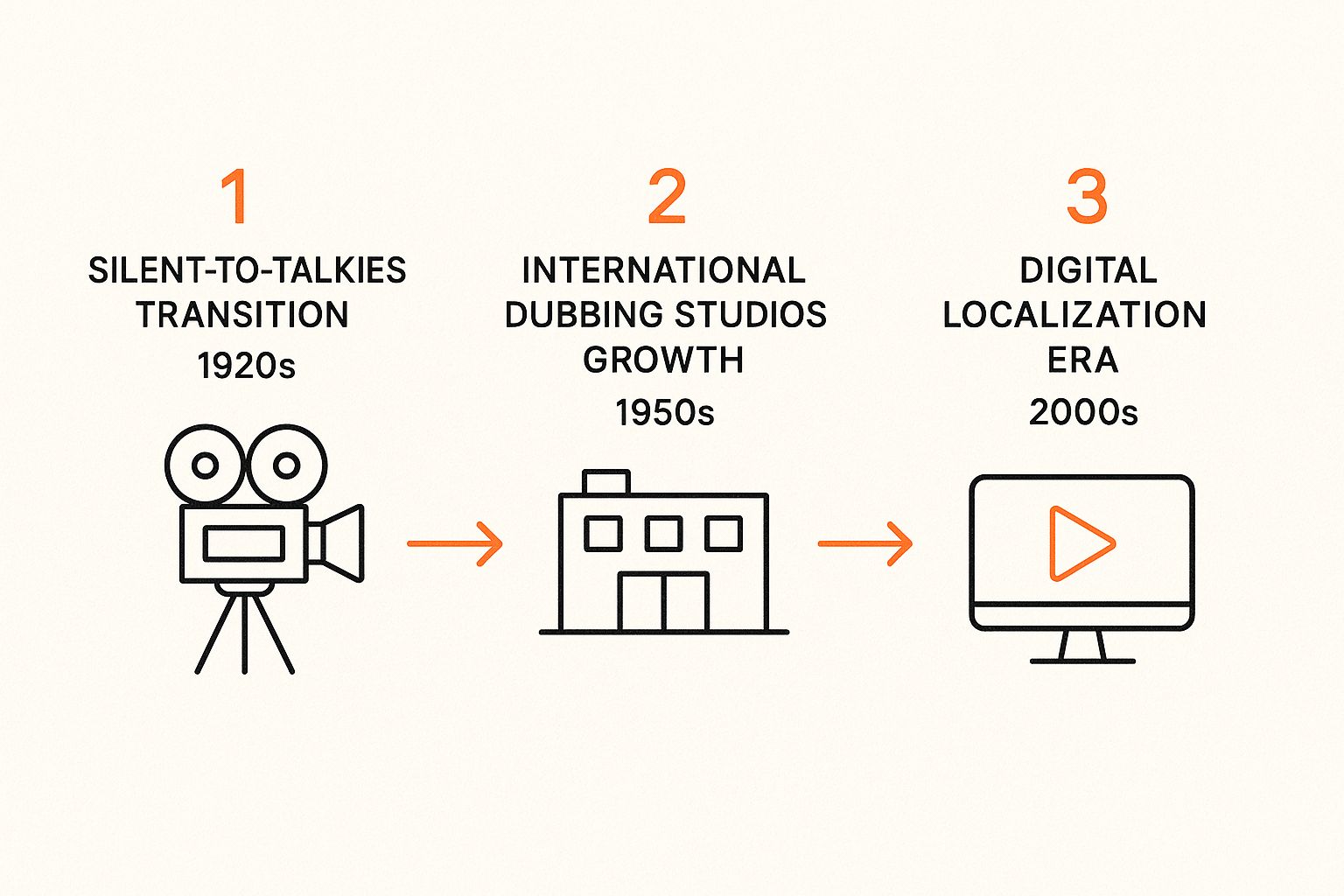
As you can see, what started as a technical necessity in the early days of "talkies" has exploded into a global industry fueled by digital innovation.
Final Mixing and Mastering
The last stage belongs to the audio engineers. Their job is to take all the newly recorded dialogue and weave it seamlessly into the film's existing soundscape. It's a delicate balancing act.
This involves:
- Balancing Levels: They have to adjust the dialogue volume so it sits perfectly with the music, sound effects, and ambient noise. Nothing should feel out of place.
- Adding Reverb and Effects: This is what makes the new voices sound like they were actually in the scene. They add effects to mimic the acoustics of a vast cavern or a tiny, cramped room.
- Mastering the Final Mix: Finally, they polish the entire audio track to create a single, cohesive, and immersive experience for the viewer's ears.
This meticulous, multi-step process really shows why high-quality traditional dubbing is both a major investment and a deeply respected art form.
Exploring the Different Flavors of Dubbing
You’ve probably noticed that not all dubbing sounds the same, and that’s entirely on purpose. The right technique depends on the type of content and the experience you want the audience to have. The style you see in most big-budget movies is by far the most complex.
This method, called lip-sync dubbing, is the gold standard for narrative films. The whole point is to make the new dialogue perfectly match the on-screen actor's lip movements. It's a painstaking process, but when it's done right, you completely forget you're even watching a dubbed film. A huge part of pulling this off is knowing how to expertly sync audio with video.
More Than Just Matching Lips
But that seamless, invisible effect isn't always the goal. For things like documentaries or news reports, a completely different approach often makes more sense.
This is where voice-over, sometimes known as "UN-style" dubbing, enters the picture. With this technique, the original speaker's audio is still there, just turned down low, while a narrator's translated voice is layered on top at a much clearer volume. It’s a great way to keep the authenticity of the original speaker while making sure the information is easy for everyone to understand. If you want to dive deeper, we have a whole guide covering the details of voice over recording.
Then there's lektoring, a less common but fascinating method popular in parts of Eastern Europe, especially Poland. Here, a single narrator—usually a man with a very neutral tone—reads all the translated lines for every single character. The original audio track plays quietly underneath. It can be a little jarring if you're not used to it, but for local audiences, it's a perfectly normal and accepted way to watch foreign films.
The chosen dubbing technique is a deliberate artistic and cultural choice. It directly shapes how an audience connects with the content, balancing immersion, authenticity, and clarity.
The Unique World of Animation Dubbing
Animation has its own special workflow that basically flips the whole process on its head. For most animated movies and shows, the voice actors record their lines before a single frame is animated.
This "voice-first" approach is a dream for animators. It gives them total freedom to design a character’s expressions, mouth movements, and even body language to perfectly match the emotion and timing of the actor's performance. It’s the reason animated characters often feel so alive and why their lip movements look flawless—the visuals were literally built around the voice.
The Hidden Challenges of Dubbing
While dubbing opens up a world of content, the process itself is packed with artistic and technical hurdles. It’s a delicate balancing act, and even the most experienced studios have a tough time getting it just right.
At the heart of it all is the age-old debate around authenticity. Many purists and critics argue that even the most skillful dub can never fully capture the unique nuances, tone, and emotional weight of the original performance. A voice is an instrument, and replacing it means some of the original music is inevitably lost.
The Technical Tightrope of Synchronization
Beyond the artistic debate is the technical beast of lip-sync. Getting the new dialogue to match the on-screen actor's mouth movements perfectly is incredibly difficult.
If it's off by even a fraction of a second, the effect is jarring and uncanny. It's the kind of thing that can instantly pull a viewer out of the story. This single element is often the difference between a seamless experience and a distracting one, demanding immense precision from both voice actors and audio engineers.
Navigating Cultural Minefields
Another massive hurdle is cultural translation. Language is so much more than just words; it’s loaded with idioms, inside jokes, and references that only make sense within a specific culture. A joke that's hilarious in one language might fall completely flat or, worse, be totally nonsensical in another.
The real challenge of dubbing isn't just translating what is said, but translating what is meant. It's about adapting the soul of the dialogue so it resonates emotionally with a completely different audience.
This process, often called transcreation, requires a deep, nuanced understanding of both the source and target cultures. For instance, a reference to a local celebrity in a Hollywood film would need to be swapped with an equivalent local figure to land with the same impact on an international audience.
The industry also faces some very real resource constraints. Despite its growth, there’s a 26% shortage of skilled native voice actors, and studios report that 18% of their difficulties are tied to audio-visual synchronization. This really highlights how demanding the work is, requiring a unique blend of talent and technical skill. You can learn more by digging into recent industry analyses covering the film dubbing market and its challenges.
The Barriers of Cost and Time
Finally, the sheer cost and time involved in a high-quality traditional dub are significant barriers. Professional dubbing is a labor-intensive process that involves writers, casting directors, talented voice actors, and sound engineers.
For a single film, this can take months and cost tens, or even hundreds, of thousands of dollars for each language. This is often a major roadblock, especially for independent creators who want to share their work with the world but don't have a major studio budget. Perfecting the delivery takes serious skill, and anyone interested in the craft can explore various voice acting techniques for beginners to get a feel for the fundamentals.
How AI Is Changing the Dubbing Game
The old-school world of dubbing—long, expensive, and incredibly labor-intensive—is getting a serious shakeup, and it's all thanks to artificial intelligence. Where studios used to get stuck on finding the right talent, booking studio time, and managing massive budgets, AI is stepping in to automate and improve the whole workflow. This isn't some far-off future concept; it's happening right now.
One of the coolest developments is AI voice cloning. This tech can listen to an actor's original performance, analyze their unique vocal patterns, and then replicate it in a completely different language. Think about hearing your favorite movie star speak perfect Japanese or Spanish, but it still sounds exactly like them. It's a game-changer for keeping the original performance's soul intact across any language.
Then there's AI-powered lip-sync. This directly tackles one of the most notoriously tricky parts of dubbing. The AI can actually adjust the translated script to match the on-screen actor's mouth movements with stunning precision, getting rid of that distracting, out-of-sync feeling.
Making Dubbing Accessible to Everyone
This tech isn't just making things faster; it's changing who gets to create content for a global audience. For decades, high-quality dubbing was a luxury only big-budget Hollywood productions could afford. Not anymore.
AI is basically democratizing localization. It’s tearing down the walls of cost and time that used to box content into its original language. This means anyone, from indie filmmakers to marketers, can now reach a worldwide audience.
This is exactly where tools like Lazybird fit in. Using powerful text-to-speech technology, our platform lets creators generate polished, natural-sounding voice-overs and initial dubs in minutes. Forget waiting months for a studio.
The New Hybrid Workflow
Don't mistake this for AI completely replacing human actors. What's really happening is the birth of a smarter, more efficient workflow. Creators can now use AI to generate a perfectly timed and translated base dub. From there, human voice actors can step in to add the final layer of polish and emotional depth.
This hybrid approach has some massive upsides:
- Speed: A project that used to take weeks of studio sessions can now be roughed out in an afternoon.
- Cost-Effectiveness: It cuts down on the huge expenses tied to studio rentals, casting calls, and endless recording takes.
- Consistency: For a long TV series or a set of training videos, AI keeps the voice and tone perfectly consistent from start to finish.
- Scalability: You can dub one video into ten or twenty languages at once, something that was a logistical nightmare with the old methods.
By letting AI handle the technical heavy lifting—the tedious translation and timing—human actors are freed up to do what they do best: deliver a performance that truly connects with the audience. If you're ready to jump in, learning how to use AI voice tools is your first step. It's a modern approach that’s completely redefining what’s possible for movie dubbing and all kinds of digital media.
Got Questions About Movie Dubbing? We've Got Answers
As dubbing brings more global stories to our screens, it’s only natural to have a few questions. The whole process touches on everything from cultural habits to creative choices and the future of filmmaking itself. Let's clear up some of the most common questions people have.
Why Do Some Countries Dub Everything, While Others Use Subtitles?
It really boils down to history, culture, and what audiences are used to.
In places like Germany, Italy, and Spain, dubbing has been the standard for decades. Generations of moviegoers grew up hearing Hollywood stars speak their language, so it just feels normal. It creates a seamless experience without the distraction of reading text.
Dubbing also makes movies accessible to everyone, especially young kids who can't read yet or people with visual impairments. On the flip side, countries in Scandinavia or the Netherlands prefer subtitles because they value hearing the original actors' performances and often have a high level of English proficiency.
Does Dubbing Ruin the Original Movie?
That's the million-dollar question, isn't it? A great dubbing team works tirelessly to make sure the answer is a firm "no."
Their job isn't just to translate words; it's a creative process called transcreation. Think of it as adapting the soul of the movie. They have to figure out how to make a joke land or a cultural reference make sense for a whole new audience, all while keeping the story's emotional core intact.
Of course, a rushed or poorly funded dub can definitely miss the mark, flattening a character's personality or completely fumbling the humor. The real goal is to capture the original feeling.
A successful dub isn't about being a word-for-word copy. It's about making a German, Japanese, or Brazilian audience feel the exact same thrill, laugh, or heartache as the original American audience did. It's emotional translation, not just language.
What’s the Price Tag for Dubbing a Movie?
The cost can swing wildly depending on the project. For a big Hollywood blockbuster, you could be looking at anywhere from $50,000 to hundreds of thousands of dollars to dub it into a single language.
So, what drives that cost? A few key things:
- The length of the film and how much dialogue there is.
- The number of characters who need a unique voice actor.
- How famous (and expensive) the voice talent is.
- The complexity of the final sound mix and engineering.
This is exactly why affordable, AI-powered tools are making such a big splash. They give indie filmmakers and creators a real shot at reaching global audiences without needing a Hollywood-sized budget.
Is AI Going to Take Over and Replace Human Voice Actors?
Not anytime soon. While AI has become an amazing partner in the dubbing studio, it’s not ready for a solo career just yet.
AI is fantastic at handling the heavy lifting—things like getting a first-pass translation done, synching the new dialogue to the actors' lip movements, and even creating realistic voice clones. It's a massive time-saver.
But what it can't do is replicate the spark of a human performance. The subtle cracks in a voice during a sad scene, the creative choices an actor makes to bring a line to life, the perfect imperfection that makes a character feel real—that’s still human territory. The future is a team effort: AI does the technical prep work, and human actors step in to deliver the final, emotional performance that truly connects with us.
Ready to bring your stories to a global audience without the traditional costs and complexities of dubbing? Lazybird empowers you to create high-quality, natural-sounding voice-overs in minutes. Whether for film, marketing, or educational content, discover how our AI-powered text-to-speech platform can make your voice heard worldwide. Try it for free today.
